

Tripartite Template (TPT) V8
Europe
Checks Solvency II Tripartite Template (TPT) V8 files: the fund look-through files asset managers send insurers, one row per position.
From the TPT V8 field list. V8 is mandatory from the end-March 2027 reports.
- 157validation rules
- 5pipeline stages
- 3 minto build and check
See it in Quantemplate
The pipeline
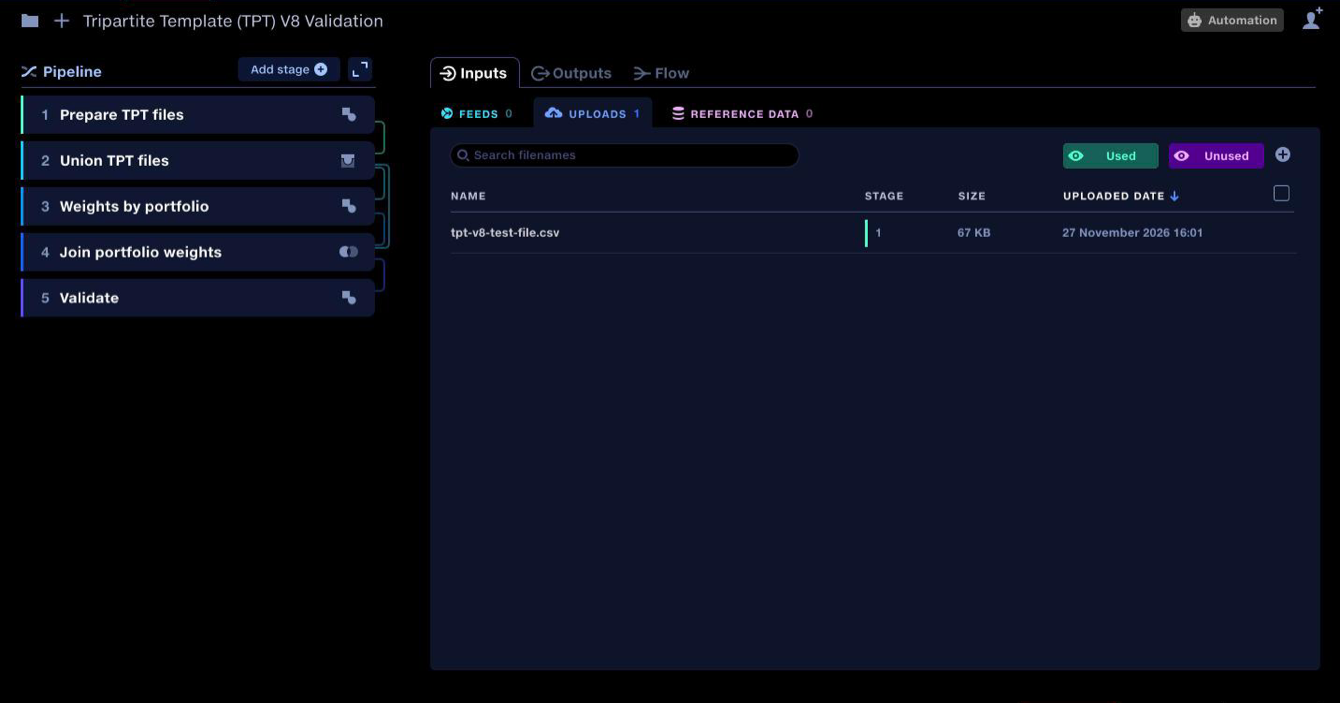
The flow
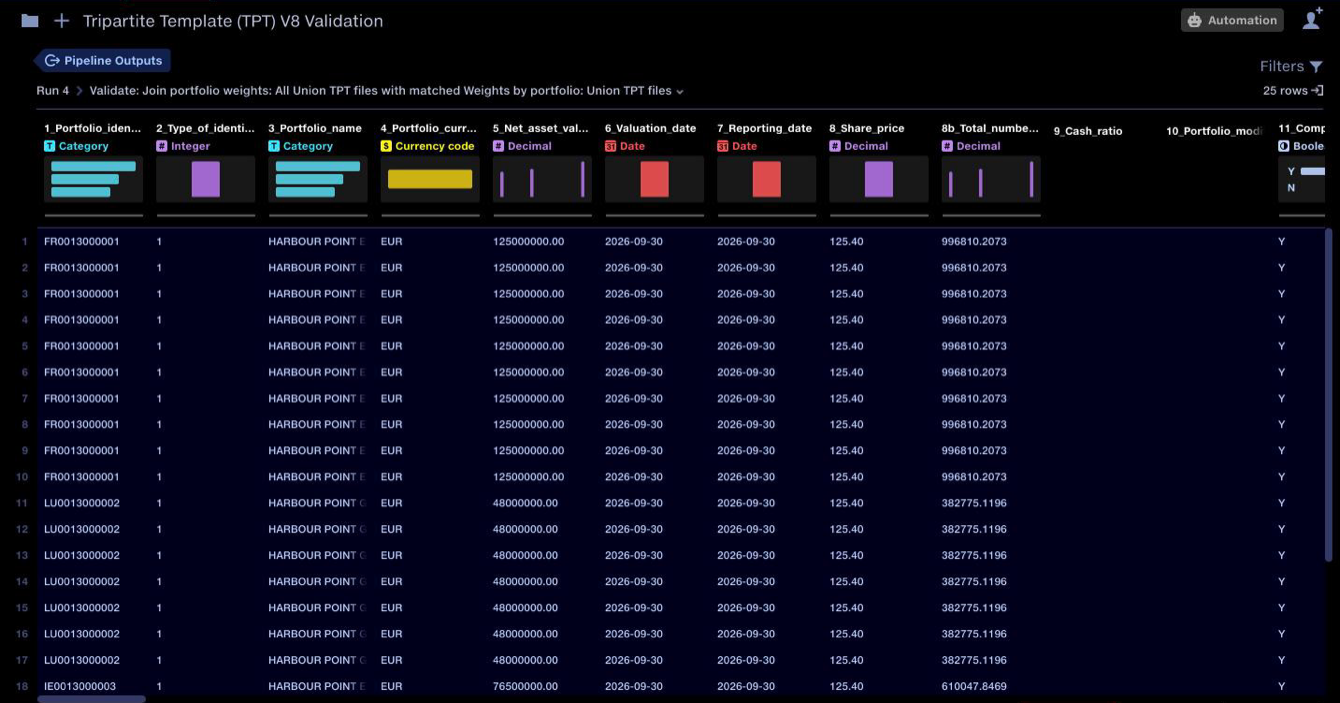
The checked output
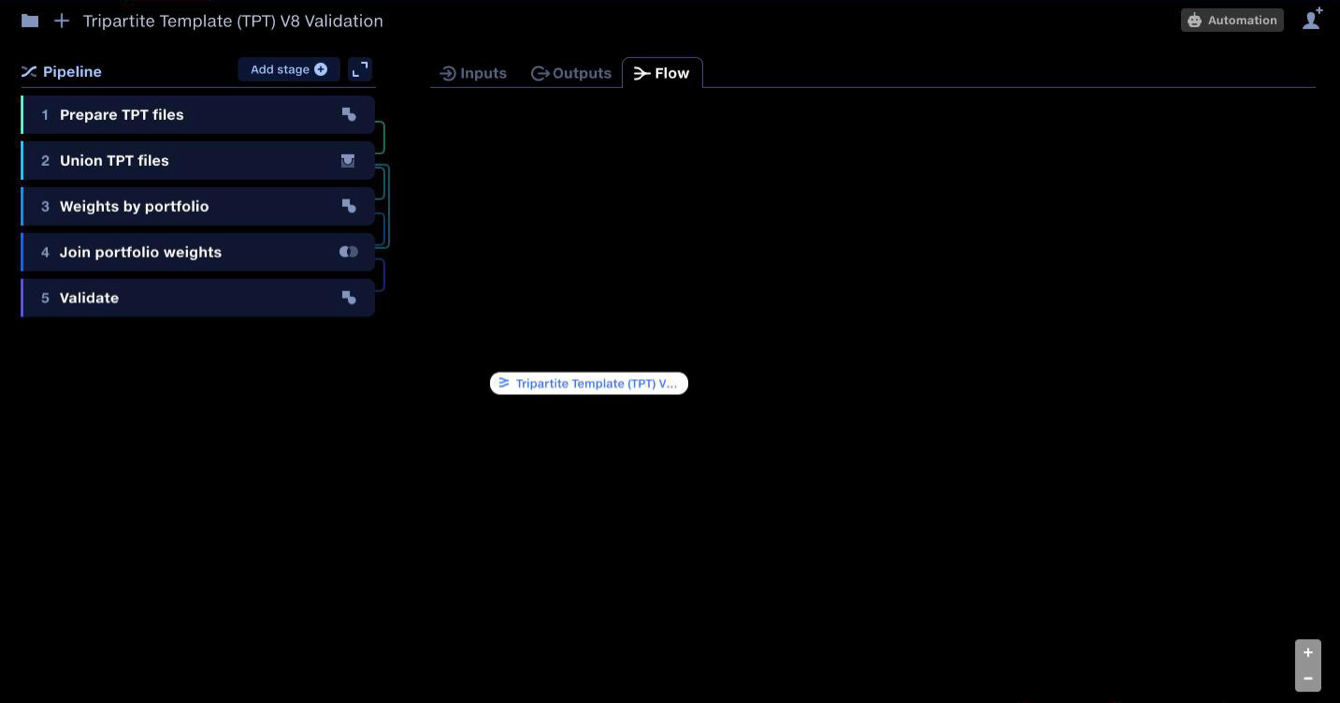
What it checks
157 rules 151 Fail 6 Warning
- Mandatory fieldsFields every asset category needs aren’t blank 33 Fail 33
- Fields by asset categoryFields some asset categories need are filled in 45 Fail, 3 Warning 48
- FormatsNumbers, dates, currency and country codes, flags and CIC codes 72 Fail 72
- ConsistencyWeights match valuations and add up to 100% per portfolio 1 Fail, 3 Warning 4
A rule set to Fail marks its rows as failed, and any failure blocks Auto Export if you set it up. Warnings are only reported. Validation never removes a row. Every rule and its formula is listed in VALIDATIONS.md in the download.
How the pipeline works
- Stages 1–2 Prepare and union Tidy each TPT file and stack them
- Stage 3 Weights by portfolio Add up the valuation weights for each portfolio
- Stage 4 Join Bring each portfolio’s total weight onto its positions
- Stage 5 Validate Run the 157 rules
What’s in the download
- The 157 rules as JSON, and a table of every rule with its formula and notes
- The TPT V8 template the rules are generated from
- A good TPT file, and a test file with positions built to fail each rule
- The number of rows each rule should flag on the test file
- A Claude skill that builds the pipeline and checks the results
- A snapshot of the finished pipeline and the scripts that build it from your browser
Build it
- Unzip the download and copy the folder in
skillsinto~/.claude/skills/. - With Claude in Chrome signed in to Quantemplate, ask Claude Code:
Build the TPT V8 pipeline from the tpt-v8 folder.
- Claude creates the datasets and stages, runs the test data and checks every rule’s result. This takes around 3 minutes.
The agent builds through the Quantemplate app’s own API in your browser. That API isn’t published, so if a release changes it, the build stops and the agent offers to click through the screens instead, which takes much longer. Review what the agent builds before you rely on it.
Using real files
- Add each asset manager’s TPT file as an input to stage 1.
- Add rules for the closed lists you rely on, such as the type of identification code.
Contact the Quantemplate support team, or use your AI agent, to build custom logic for your use case.
Limits
- Conditions written in words, such as “if item 32 set to Floating”, aren’t checked. The asset categories marked plainly in the template are.
- Optional and N/A fields are only format-checked, and only when filled in.
- It checks the file, not the look-through. Turning positions into Solvency II S.06.02 rows is a separate step.
- The test data is fictional.
- The build doesn’t set up Auto Run, Auto Export or feeds.
- The agent works through the app in your browser, so changes someone makes in the app whilst it’s working can trip it up.