

Lloyd’s v5.2 written bordereaux
Europe
Checks each risk’s whole written premium against Lloyd’s ‘Europe and LBS Written’ tab.
From Lloyd’s Coverholder Reporting Standards v5.2: ‘Europe and LBS Written’ tab
- 101validation rules
- 11pipeline stages
- 136columns
- 4 minto build and check
Build the premium bordereaux template first, in the same workspace. It uses that template’s binder terms.
See it in Quantemplate
The pipeline
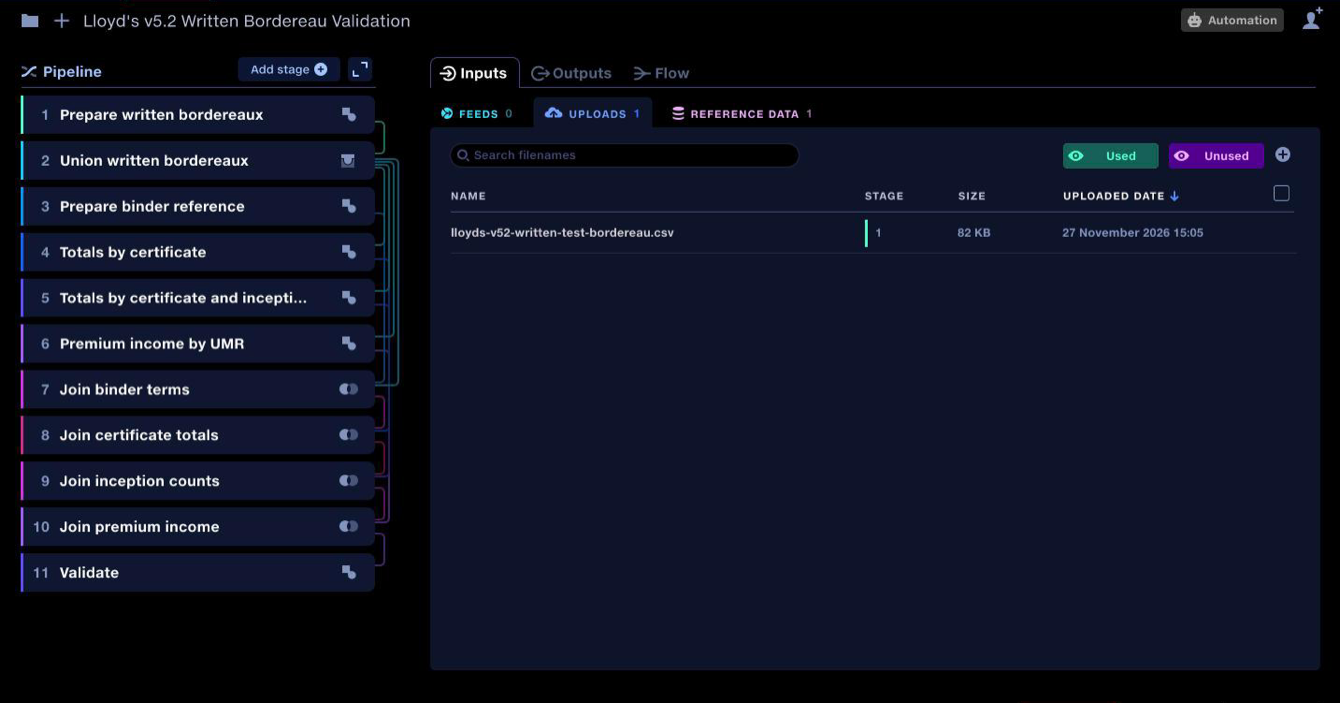
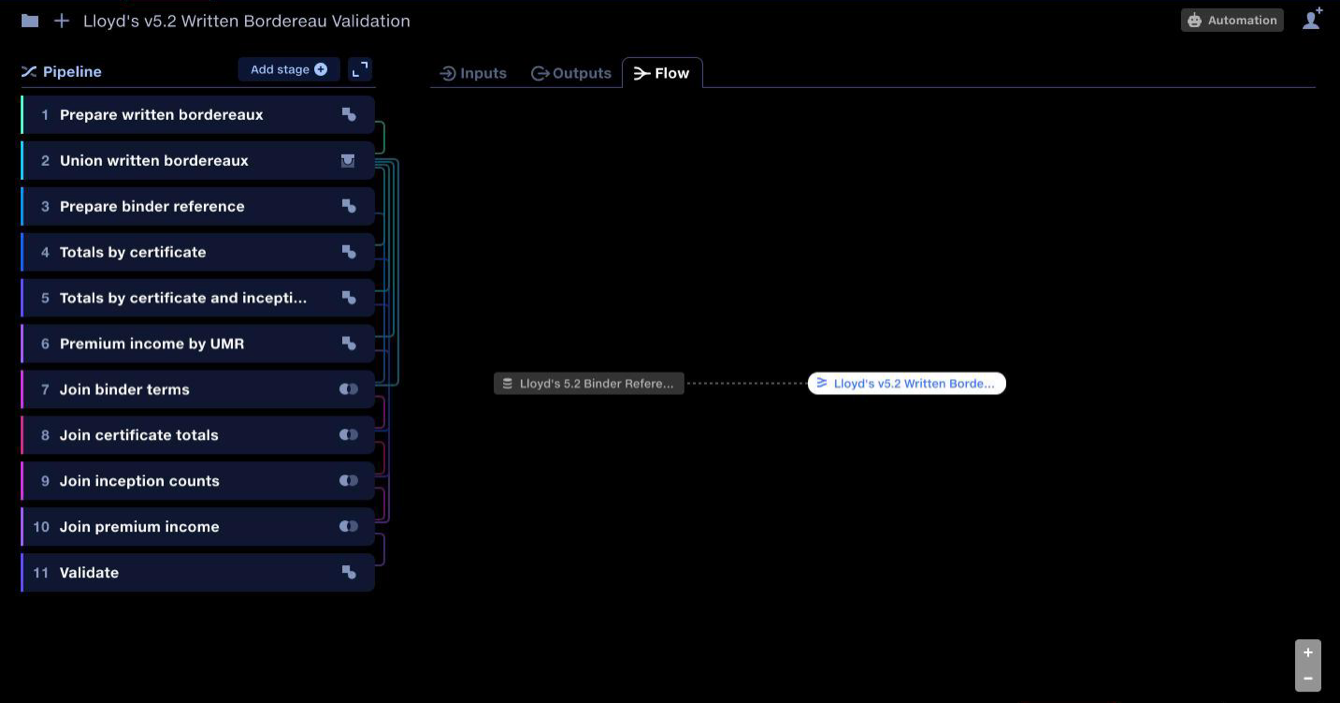
The flow
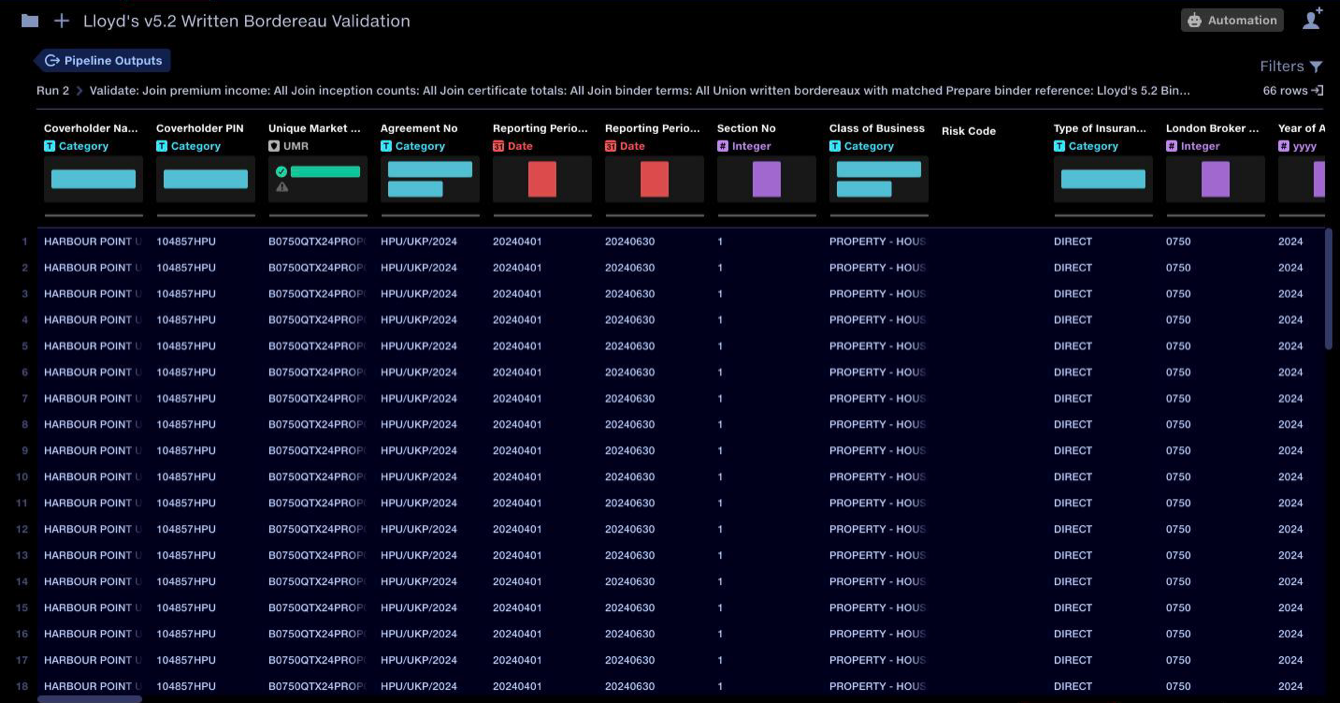
The checked output
What it checks
101 rules 68 Fail 33 Warning
- Mandatory and yellow fieldsRed fields aren’t blank; yellow fields are given 19 Fail, 8 Warning 27
- Types and formatsCode lists, identifier formats and value ranges 10 Fail, 9 Warning 19
- Within a rowBrokerage, net premium, commission and periods 5 Fail, 1 Warning 6
- Against the binderTerritories, commission, dates and sum insured fit the binder 11 Fail 11
- Across rowsDuplicates, returns, and premium against the income limit 3 Fail, 2 Warning 5
- Additional checksDates, currencies, signs, taxes and country fields 20 Fail, 13 Warning 33
A rule set to Fail marks its rows as failed, and any failure blocks Auto Export if you set it up. Warnings are only reported. Validation never removes a row. Every rule and its formula is listed in VALIDATIONS.md in the download.
How the pipeline works
- Stage 1 Prepare Tidy the bordereaux: headers, column names, text and dates
- Stage 2 Union Stack the bordereaux into one dataset
- Stage 3 Binder terms Clean each binding authority’s terms
- Stages 4–6 Totals Add up premium by policy, inception date and binder
- Stages 7–10 Joins Bring binder terms and totals onto every row
- Stage 11 Validate Run the 101 rules
What’s in the download
- The 101 rules as JSON, and a table of every rule with its formula and notes
- Master schema data, and test bordereaux with rows built to fail each rule
- The number of rows each rule should flag on the test bordereaux
- A Claude skill that builds the pipeline and checks the results
- A snapshot of the finished pipeline and the scripts that build it from your browser
- Lloyd’s template the rules are generated from (© Lloyd’s)
Build it
- Build the premium bordereaux template first, in the same workspace.
- Unzip the download and copy the folder in
skillsinto~/.claude/skills/. - With Claude in Chrome signed in to Quantemplate, ask Claude Code:
Build the Lloyd’s v5.2 written bordereaux pipeline from the lloyds-v52-written folder.
- Claude creates the datasets and stages, runs the test data and checks every rule’s result. This takes around 4 minutes.
The agent builds through the Quantemplate app’s own API in your browser. That API isn’t published, so if a release changes it, the build stops and the agent offers to click through the screens instead, which takes much longer. Review what the agent builds before you rely on it.
Using real bordereaux
- Replace the binder terms with your own, keeping the column names.
- Add your written bordereaux as inputs to stage 1.
- Adapt the mapping of transaction codes (OP, AP and RP) for each coverholder.
Contact the Quantemplate support team, or use your AI agent, to build custom logic for your use case.
Limits
- Yellow fields are reported as warnings, because whether one applies depends on the binder.
- 74 of the rules are the premium template’s, adapted to the written tab’s columns. 16 premium rules are left out because the tab doesn’t have their columns.
- Column types are set by the build, not detected from your data. Choosing the master schema again makes Quantemplate detect them, which may change some types.
- The build doesn’t set up Auto Run, Auto Export or feeds.
- The agent works through the app in your browser, so changes someone makes in the app whilst it’s working can trip it up.